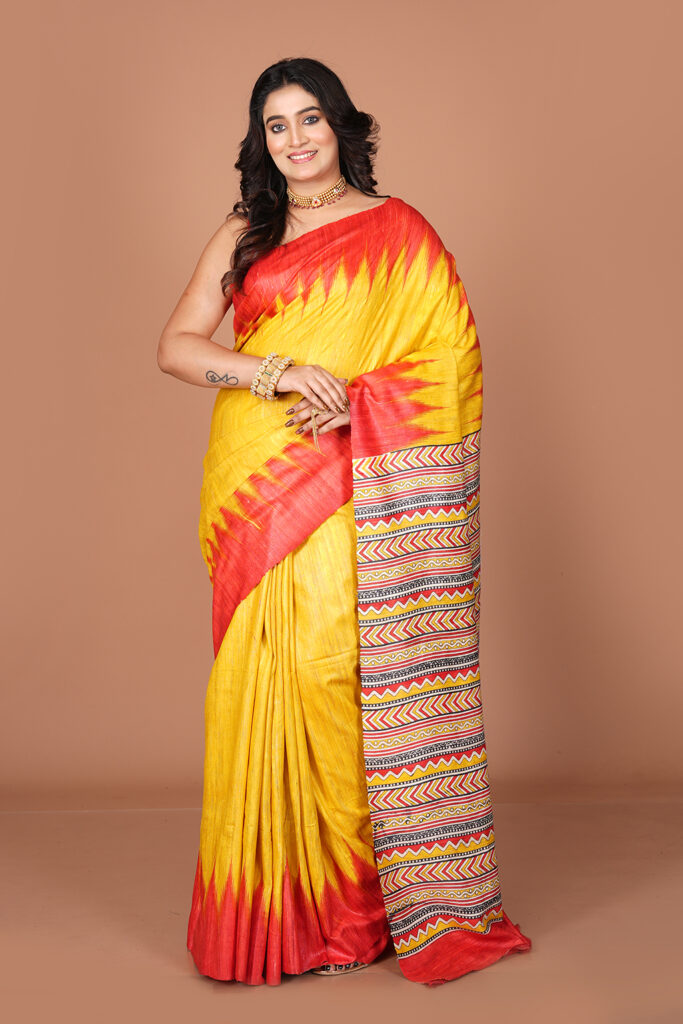
Temple Border Silk Saree Online: Traditional Motifs, Timeless Elegance
Loominators stocks temple border silk saree online pieces built the way they’ve always been built, body and border woven as two separate pieces, then locked together by hand. That single join is the whole reason this saree exists in the form it does, and it’s worth understanding before you look at anything else on this page.
How a Temple Border Comes Together
It starts with two weavers at the same loom, working toward each other. One handles the body, feeding thread from one side. The other works the border, usually in a contrasting color, from the other side. Neither section is finished on its own, a korvai silk saree only becomes whole at the exact point where the two meet, interlocked thread by thread rather than stitched or sewn on afterward. That joining point is where all the skill sits. Get it wrong, and the border starts pulling loose from the body within a few wears.
Field Guide: Name That Border
Not every temple border looks the same, and the differences actually have names:
-
Six Temple Rekku: six-pointed gopuram triangles, with a smaller spacer triangle set between each one
-
Pillaiyar Mukku: a five-pointed version of the same idea, sometimes worked on just one side of the border, sometimes both
Both are variations on a single concept: small triangles standing in for the gopuram spires of Kanchipuram’s temples, repeated in a tight, unbroken row along the edge of the saree.
Where Temple Border Sits
A kanjivaram temple border saree isn’t the only border style Kanchipuram weavers make. Rettai Pettu carries two parallel border lines instead of one continuous triangle row, and some sarees skip the border altogether for a plain, unbroken drape. Temple border is the one most people picture the moment they hear “Kanjivaram”, the triangles are unmistakable once you know to look for them.
Spot the Join
Look closely at the point where border meets body. On a genuine piece, the interlock sits tight and even, with no visible stitching line or glued overlap. Run a finger along it — you should feel a slight ridge where the two separate weaves lock together, not a flat, sewn-on seam.
Fabric Options
Most temple border pieces here are woven in pure mulberry silk with real zari, which is what gives a korvai contrast border saree its weight and shine. A silk-cotton version exists too, for anyone who wants the same border style in a lighter, more everyday-wearable fabric.
Occasions to Wear
This one leans bridal. Temple border Kanjivaram sarees are a standard choice for South Indian weddings, muhurtham ceremonies, and receptions, though a lighter silk-cotton piece works just as well for temple visits or festive family functions.
Styling
Traditional gold jewelry and a classic bun are the standard pairing here — the border pattern is bold enough on its own that it doesn’t need much competition from the rest of the look.
What Affects the Price
Zari content drives most of the cost, followed by how many colors were used in the border and how many days of weaving actually went in, a genuine piece typically takes seven to fifteen days on the loom.
Care guidance
Dry clean only. Store folded in muslin, not plastic, and avoid creasing directly along the join line between body and border, since that’s the most delicate point on the whole saree.
Why Shop with Loominators
-
Genuine Korvai joins, checked by hand before listing
-
Sourced from weavers who still work in pairs, the way the technique actually requires
-
Available in both pure silk and silk-cotton
-
Help choosing a border pattern if you’re unsure which one suits your occasion
Frequently Asked Questions
What does Korvai actually mean?
It’s the weaving technique where the body and border of a saree are made separately, then interlocked together by two weavers working on the same loom.
Is a temple border saree the same as a Kanjivaram saree?
Temple border is a specific motif found on many Kanjivaram sarees, not a separate craft on its own, it’s one of several border styles Kanchipuram weavers make.
How can I tell if the Korvai join is genuine?
Check the point where the border meets the body. A real join is interlocked, with a slight ridge you can feel by hand, not a flat, stitched-on seam.
Is a temple border silk saree suitable for weddings?
Yes, it’s one of the most common choices for South Indian bridal wear and wedding functions specifically.
Can I buy a temple border silk saree online from Loominators?
Yes, we ship pan-India, and you can browse our Temple Border / Korvai Silk Saree collection right here.