

A pure Bishnupuri silk saree usually costs anywhere between ₹3,000 and ₹15,000, depending on the weave, the amount of handwork, and whether it’s woven in Katan silk or a blend. But that single range hides a lot — a plain, lightly-worked piece and a hand-detailed Katan saree with woven motifs can sit ₹9,000 apart, and still both get sold online as “Bishnupuri silk.”
This guide breaks every price band down by weave type, walks through the specific factors that move the number up or down, and explains where Bishnupur’s own weaving tradition fits in — so you know exactly what you’re paying for before you buy, whether that’s a ₹4,000 daily-wear piece or a ₹13,000 festive one.
Price Snapshot: What ₹1,500 to ₹15,000+ Actually Buys You
| Price Range | What You’re Likely Getting | Best For |
| ₹1,500 – ₹3,000 | Printed or blended Bishnupuri-style sarees | Budget entry point, not pure silk |
| ₹3,000 – ₹6,500 | Semi-pure silk, simple prints or light woven detail | Daily wear, office wear |
| ₹6,500 – ₹9,500 | Pure Katan silk, plain or lightly patterned | Most popular festive range |
| ₹9,500 – ₹13,000 | Pure Katan silk with woven motifs, batik, or hand detailing | Premium festive wear, gifting |
| ₹13,000+ | Heavy handwork, rare motifs, larger pallu detailing | Special occasions, heirloom pieces |
These are general ranges — colour, motif complexity, and the specific weaver’s reputation can shift things within each band. The full breakdown below explains exactly why.
What Actually Moves the Price
Not all Bishnupuri silk sarees are priced the same way, even when two listings look nearly identical in photos. Here’s what’s really driving the number, with rough amounts each factor adds:
- Pure silk vs. blended fabric — a 100% pure silk saree typically runs ₹1,500–₹4,000 more than a silk-cotton or art-silk blend woven in the same pattern.
- Hand-woven vs. machine-assisted — traditional handloom weaving takes longer and costs more than power-loom production, even within “Bishnupuri style” sarees.
- Weave complexity — a plain weave sits at the bottom of the range; an intricate Katan weave with woven motifs or hand-batik work can add ₹3,000–₹6,000 over a plain equivalent.
- Dye process — standard chemical dyeing is the baseline; natural or vegetable dyeing usually adds ₹800–₹2,000 and tends to hold colour better over time.
- Border width and work — a simple 2-inch contrast border adds little; a wide (6-inch+) jacquard or temple-motif border can add ₹1,500–₹4,000 on its own.
- Seller markup — buying closer to the weaving cluster, or from a seller with direct sourcing, usually costs less than going through multiple layers of resellers.
Price Bands: What You Actually Get at Each Level
₹1,500 – ₹3,000: Budget Entry Point
- Printed or block-printed patterns rather than woven motifs
- Silk-cotton or art-silk blend, not pure silk
- Simple, often unlined borders
- Best for: trying the look before investing in a pure-silk piece
₹3,000 – ₹6,500: Daily and Office Wear
- Semi-pure or lighter-weight pure silk
- Simple woven detail or light printed patterns
- Standard colour palette — maroon, green, blue, mustard
- Best for: everyday elegance without festive-level cost
₹6,500 – ₹9,500: The Popular Festive Range
- Genuine Katan weave — twisted silk threads for a denser, slightly lustrous fabric
- Plain or lightly patterned body with a moderate border
- Noticeably better drape than the lower bands
- Best for: Puja, weddings-as-guest, and formal festive occasions
₹9,500 – ₹13,000: Premium Festive and Gifting
- Katan silk with woven motifs, hand-batik work, or intricate borders
- Heavier silk with a more pronounced sheen
- More weaving days behind the piece, reflected in the finish
- Best for: premium festive wear, gifting, pieces meant to last years
₹13,000+: Heirloom and Special-Occasion Pieces
- Extensive pallu detailing and rarer motif combinations
- Widest, most elaborate border work available in the range
- The closest thing to a one-off piece within Bishnupuri silk (short of true Baluchari)
- Best for: weddings, milestone occasions, pieces bought to keep
Price by Weave & Style
Bishnupur’s weavers don’t produce just one style of silk saree — and each style carries its own price logic. Here’s how the main categories compare:
| Style | Typical Price Range | What Makes It Different |
| Plain Bishnupuri Silk | ₹3,000 – ₹7,000 | Simple borders, minimal motifs — the most versatile, everyday option |
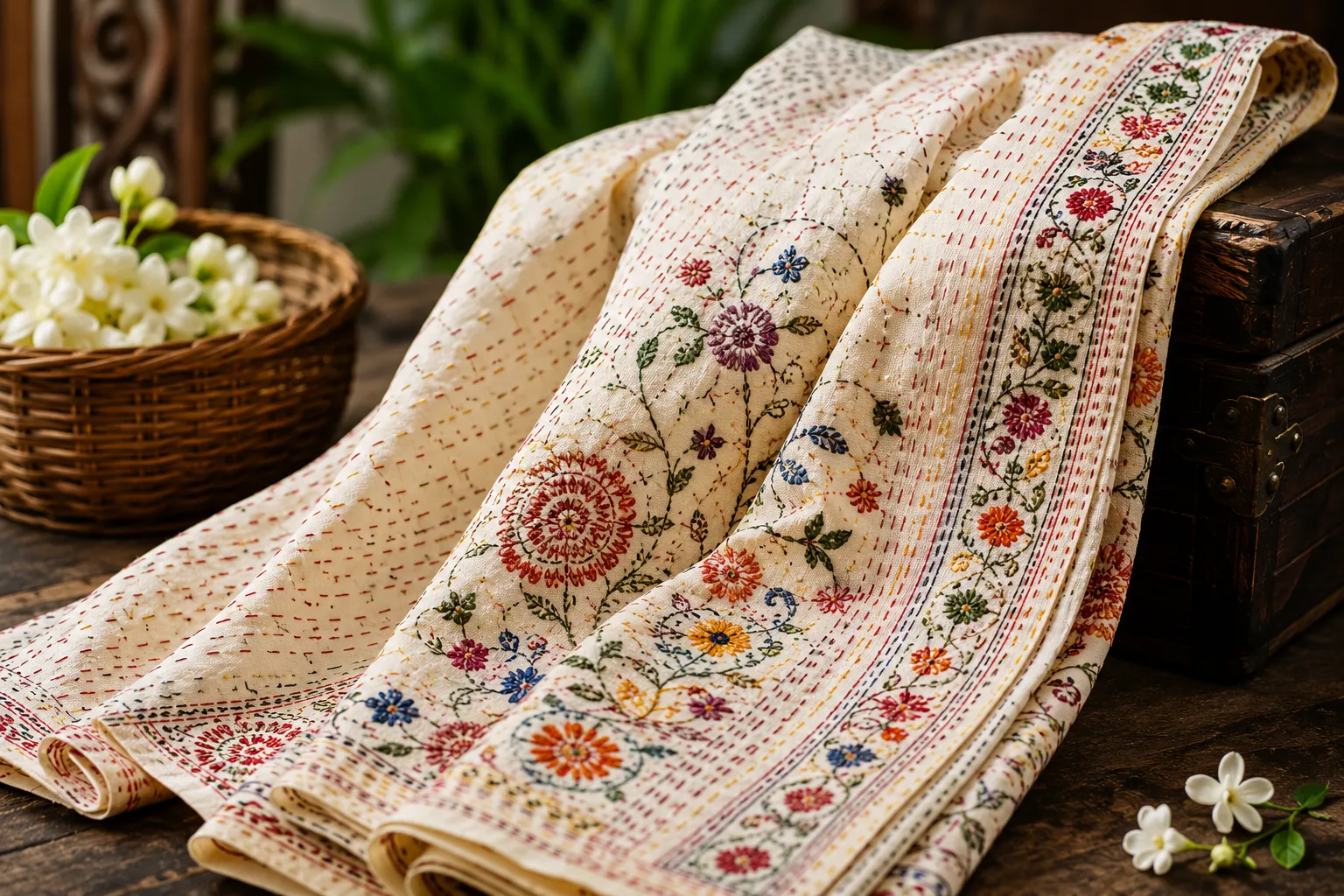
| Kantha Stitch Silk | ₹4,500 – ₹10,000 | Hand embroidery adds labour cost; every piece varies slightly |
| Batik Silk | ₹5,000 – ₹9,500 | Wax-resist hand patterns, priced for the labour rather than the fabric |
| Katan Silk (woven motif) | ₹8,500 – ₹13,000+ | The most labour-intensive weave — usually the most expensive |
If a listing doesn’t specify which of these it is, that’s often a sign the seller isn’t being fully transparent about what you’re buying — it’s worth asking before you order.
Katan Weave Explained: Why It Costs More
“Katan” refers to a specific silk-weaving technique where two or more silk threads are tightly twisted together before weaving. This twisting makes the fabric denser, gives it a slight natural sheen, and helps it hold its shape better than a single-thread weave — which is why Katan silk sarees usually sit at the higher end of the price range.
Bishnupur weavers also produce sarees in other styles, and each comes with its own price logic: plain woven silk is the most affordable pure-silk option; printed or block-printed silk adds patterns after weaving and costs less than woven motifs; batik silk is priced for the labour involved rather than the fabric alone; and Katan silk with woven motifs is the most labour-intensive option, usually the most expensive of the group.
Katan Weave vs Other Bishnupuri Weaves — and Why Price Varies
“Katan” refers to a specific silk-weaving technique where two or more silk threads are tightly twisted together before weaving. This twisting makes the fabric denser, gives it a slight natural sheen, and helps it hold its shape better than a single-thread weave — which is why Katan silk sarees usually sit at the higher end of the price range.
Bishnupur weavers also produce sarees in other styles, and each comes with its own price logic:
- Plain woven silk — the most affordable pure-silk option, with simple borders and minimal motifs.
- Printed or block-printed silk — patterns added after weaving, generally cheaper than woven motifs.
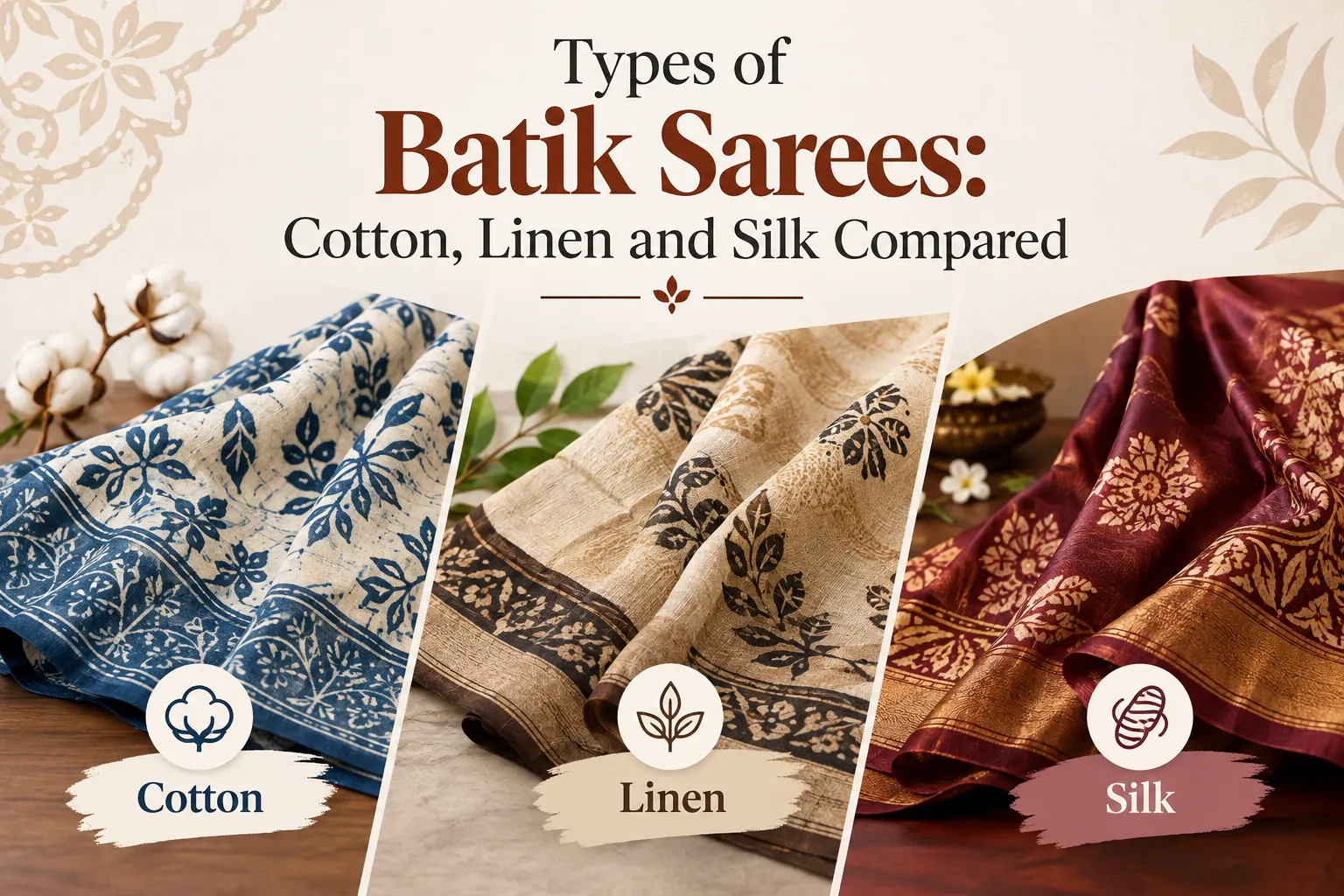
- Batik silk — wax-resist hand patterns, priced for the labour involved rather than the fabric alone.
- Katan silk with woven motifs — the most labour-intensive option, and usually the most expensive.
If a listing doesn’t specify the weave type, that’s often a sign the seller isn’t being fully transparent about what you’re buying — it’s worth asking before you order.
Bishnupuri vs. Baluchari: Two Distinct Weaves from the Same Town
Bishnupur’s weavers are known for two separate traditions, and it’s worth keeping them apart when you’re comparing prices. Baluchari sarees feature elaborate mythological motifs woven into the pallu using a distinct technique, and they carry their own — generally higher — price band because of the extra weaving time and skill involved. Bishnupuri silk, by comparison, tends to be lighter and simpler, which is part of why it works well for both festive wear and more regular use.
Some listings blur this line by labelling ordinary Bishnupuri pieces as “Baluchari-style” to justify a higher price without the actual motif work or weaving technique behind it. If a saree is priced in the Baluchari range, look for the pallu’s narrative or mythological motifs specifically — that’s the feature you’re paying the premium for, not the town it comes from.
Where Bishnupuri Silk Comes From — West Bengal’s Silk Town
Bishnupuri silk gets its name from Bishnupur, a small town in the Bankura district of West Bengal, better known historically for its terracotta temples. Silk weaving here goes back generations, with local families passing the craft down through what’s known as the Bishnupur school of weaving.
Buying from a seller with genuine ties to this region, rather than a generic “silk saree” listing, is usually a good sign you’re getting the real thing.
Buying in Kolkata vs. Buying Online
Bishnupur sits roughly 130 km from Kolkata, which is one reason Kolkata-based sellers — online or in-store — tend to have shorter, simpler supply chains to the weaving cluster than sellers in other metros. Fewer hands the saree passes through generally means less markup stacked onto the final price.
Buying online from a Kolkata-based seller also lets you compare pieces across every price band side by side, without needing to travel between physical stores or to Bishnupur itself — useful if you’re weighing a ₹4,000 daily-wear piece against a ₹12,000 festive one in the same sitting.
That said, location alone doesn’t guarantee a fair price. The checks in the next section apply whether you’re buying from a Kolkata seller, a Mumbai boutique, or an online-only store.
City-wise Bishnupuri Silk Saree Pricing Comparison
The cost of a Bishnupuri Silk Saree may differ in each city depending on several considerations like the profit margin of the shop owner, boutiques’ prices, costs of transportation, source and intricacy of the saree. The below ranges are approximate retail prices that may differ based on silk quality, weave style, designs, and zari embroidery.
| City | Approx. Bishnupuri Silk Saree Price Range |
| Bishnupur | ₹4,000 – ₹15,000+ |
| Kolkata | ₹4,500 – ₹16,000+ |
| Delhi | ₹5,500 – ₹18,000+ |
| Mumbai | ₹6,000 – ₹20,000+ |
| Bengaluru | ₹5,500 – ₹18,000+ |
| Chennai | ₹5,500 – ₹18,000+ |
| Hyderabad | ₹5,000 – ₹17,000+ |
| Pune | ₹5,000 – ₹17,000+ |
How to Tell If You’re Getting a Fair Price
Since you can’t touch the fabric before buying online, a few checks help you judge whether a price is reasonable:
- Look for the weave named specifically (Katan, plain woven, batik) rather than a vague “pure silk” claim.
- Check for GI tag or Silk Mark mentions, where the seller offers them.
- Be cautious of “pure silk” sarees priced well below ₹3,000 — that’s usually a sign of blended fabric.
- Ask about the dyeing process if colour-fastness matters to you.
- Real, close-up photography of the weave and border is a good trust signal — heavily filtered or stock-style photos are not.
- If a saree is priced in the Baluchari range, confirm the pallu actually carries narrative or mythological motifs, not just the Bishnupur name.
Where to Buy Bishnupuri Silk Sarees Online
If you’d rather skip the guesswork, here are a few genuine Bishnupuri silk sarees across different price bands:
Entry-level pure silk — Premium Bishnupur Pure Silk Saree → https://loominators.in/product/female/indian/saree/premium-bishnupur-pure-silk-saree-ivory-cream-with-sky-blue-floral-print-slate-grey-border/
Popular festive range — White & Mustard Yellow Bishnupuri Saree → https://loominators.in/product/female/indian/saree/white-mustard-yellow-bishnupuri-saree/
Woven motif work — Premium Off-White Woven Bishnupuri Silk Saree → https://loominators.in/product/female/indian/saree/premium-off-white-woven-bishnupuri-silk-saree-with-maroon-traditional-border/
Hand-batik detailing — Bishnupur Handcrafted Batik Silk Saree → https://loominators.in/product/female/indian/saree/bishnupur-handcrafted-batik-silk-saree/
Browse the full collection to see current designs and availability:
View Full Bishnupuri Silk Collection → https://loominators.in/product-category/female/indian/saree/
Frequently Asked Questions
How much does a pure Bishnupuri silk saree cost?
Prices typically range from ₹6,500 to ₹13,000 for pure Katan silk, depending on how intricate the weave or handwork is. Simpler printed or blended versions can start around ₹1,500–3,000, though these are not pure silk.
What is Katan silk?
Katan is a weaving technique where two or more silk threads are tightly twisted together before weaving, producing a denser fabric with a subtle natural sheen. It’s considered one of the more premium Bishnupuri weaves.
Is Bishnupuri silk genuine silk?
Pure Bishnupuri silk sarees are 100% silk, though many sellers also offer silk-blend or art-silk versions at lower prices. Checking the fabric description carefully, and looking for GI tag or Silk Mark mentions, helps confirm what you’re buying.
How can I tell if a Bishnupuri saree is authentic before buying online?
Look for the weave type named specifically, close-up photography of the border and texture, GI tag or Silk Mark certification where available, and a price that’s realistic for the level of handwork described.
What’s the difference between Bishnupuri and Baluchari sarees?
Both come from the Bishnupur region of West Bengal, but Baluchari sarees feature elaborate mythological motifs woven into the pallu, while Bishnupuri silk sarees are generally lighter and simpler, making them suited to both festive and regular wear.
Is Bishnupuri silk good for everyday wear?
Lighter, plain-woven Bishnupuri silk sarees are comfortable enough for regular or office wear, while more heavily worked Katan or batik pieces are better suited to festive occasions.
What’s the price difference between Katan and plain Bishnupuri silk?
Plain Bishnupuri silk typically runs ₹3,000–₹7,000, while genuine Katan weaves start around ₹6,500 and can go past ₹13,000 with woven motifs — the twisted-thread technique and added weaving time account for most of that gap.
Is it cheaper to buy Bishnupuri silk sarees in Kolkata than other cities?
Kolkata’s proximity to Bishnupur (about 130 km away) generally means shorter supply chains and fewer markup layers compared to sellers further from the weaving cluster, though the exact saving depends on the individual seller rather than the city alone.
How do I know if a saree is Kantha stitch or Katan weave?
Kantha stitch sarees show visible hand-embroidered running stitches, often in contrasting thread, layered onto the fabric. Katan weave is a fabric construction, not embroidery — it shows up as a denser, slightly lustrous base cloth rather than surface stitching. A clear product listing should specify which one you’re getting.
Ready to shop? Explore the full collection of Bishnupuri silk sarees at Loominators, woven by artisans in Bishnupur, West Bengal.