
By the third week of April, most Kolkata wardrobes go through the same quiet reshuffle. The synthetic sarees move to the back of the almirah. The pleats that looked crisp at 9 am have given up by lunch. And someone at home, usually a mother or a grandmother, says what she has always said: wear khadi, it breathes.
She’s right. A khadi handloom saree is spun by hand and woven by hand, and that slow, uneven process leaves tiny gaps and slubs in the cloth that let air move through it. It feels cool in May, oddly warm on a December evening, and it gets softer every time it goes through the wash.
Buying one is where things get messy. Type “buy khadi handloom saree online” into Google and you’ll get thousands of listings, plenty of them mill-made cotton with the word khadi dropped into the title because it sells. Prices jump all over the place with no explanation. Photos are edited until every saree looks the same.
So we’ve put down everything our customers usually ask us before they pick a drape. What real khadi feels like. How to spot a powerloom copy on a phone screen. Which kind suits office days and which one belongs at a Durga Puja pandal. And how to shop for khadi sarees online at Loominators without the second-guessing.
Discover the Beauty of Khadi Handloom Sarees
Khadi has a texture you notice with your fingers before your eyes. Run your palm across the pallu and you’ll feel small thick spots in the yarn, places where the spinner’s hand slowed down or sped up. Mill cotton doesn’t have those. It’s too perfect.
That little irregularity is the whole point. Because the yarn is spun on a charkha and then woven on a handloom, no two lengths of khadi come out exactly alike. The weave sits slightly loose, the fabric drapes with some body to it, and the colour sinks into the fibre in a soft, slightly uneven way that printed powerloom cloth can’t copy.
Bengal knows this fabric well. Khadi spinning centres were working in and around Kolkata from the 1920s, when wearing hand-spun cloth was a political act as much as a fashion choice. A lot of our grandmothers’ first good sarees were khadi, bought for a college function or a first job, and kept for decades.
The interest hasn’t faded. If anything, it has come roaring back. According to figures released by the Ministry of MSME, sales of khadi garments grew from ₹1,081.04 crore in 2013-14 to ₹7,145.61 crore in 2024-25, a rise of about 561 percent in eleven years. That’s a lot of people choosing hand-spun cloth on purpose.
Why Choose Khadi Handloom Sarees from Loominators?
We’re a Kolkata label with a real address, 109/D S.P. Mukherjee Road, and a big share of our saree shelf is Bengal craft: Bishnupuri silk, Baluchari, Kantha. That matters with khadi. Fabric this natural behaves differently from one batch to the next, and it helps to buy from people who actually handle the cloth rather than a warehouse reselling someone else’s photos.
A few things we do that shoppers tell us they like:
- Every listing names the fabric plainly (cotton, linen-cotton, tussar, art silk) instead of hiding behind words like “premium blend”.
- You can message us on WhatsApp at +91 98300 54954 and ask for a close-up of the weave before you pay. We’d rather send three extra photos than handle a return.
- Cash on delivery is available, and prepaid orders ship free.
- New pieces go up every Friday, so the shelf you saw last month probably looks different now.
If something doesn’t sit right once it arrives, you have seven days to send it back. Our return and exchange policy spells out the conditions in plain language, so read it once before you order a high-value piece.
Honestly, the biggest reason to shop with a small store is accountability. When a customer in Salt Lake or Howrah has a question about how her saree will wash, she’s talking to the same people who chose it. You can browse the full range of sarees we carry to see how the handloom pieces sit next to the Banarasi, Batik and block-printed drapes.
Explore Traditional Khadi Sarees for Women
“Khadi” isn’t one look. It covers everything from a thick, nubby everyday cotton to a fine count that’s almost see-through against the light. Before you start scrolling, it helps to know which kind you’re actually after.
| Type | How it feels | Best for | Season |
|---|---|---|---|
| Plain khadi cotton saree with contrast border | Medium weight, a little crisp after starch | Office, college, daily wear | March to October |
| Fine-count (muslin) khadi | Light, airy, slightly sheer | Day functions, summer lunches | Peak summer |
| Khadi silk | Dry hand-feel, soft sheen, holds pleats well | Pujas, weddings, evening events | All year |
| Jamdani or woven-motif khadi | Textured, with raised or woven-in motifs | Festive days, gifting | October to February |
| Hand-painted or block-printed khadi | Depends on the base, usually cotton or silk | Art events, casual festive | All year |
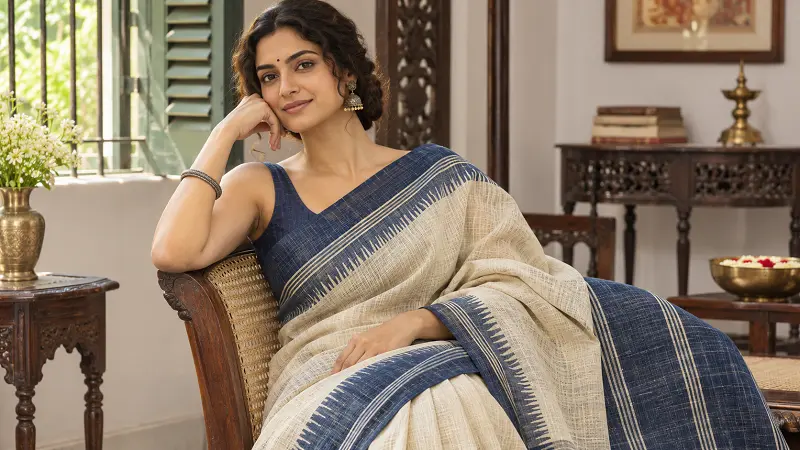
The plain khadi cotton saree is where most people should start. It’s forgiving, easy to wash at home, and works with nearly any blouse you already own. A white or natural ecru body with a red, maroon or black border is the classic for a reason.
Khadi silk is a different animal. It doesn’t shine like Banarasi or Kanjivaram. The lustre is quieter, closer to matte, and the fabric has a slightly grainy hand that some people love and some people find too dry. If you’ve never worn it, try it at a Puja evening before you commit to buying it for a wedding.
Fine-count khadi is the one to be careful with. It’s gorgeous, but it wrinkles if you look at it, and it needs a slip petticoat in a matching tone. The most common complaint with muslin-weight drapes has nothing to do with the weave. It’s the petticoat showing through in daylight.
On our own shelf, the handwoven pieces sit in the handloom and printed saree collection. One that buyers often reach for if they want the khadi feel without the weight is an off-white linen-cotton handloom with swan motifs and a geometric temple border. It breathes the way khadi does and holds a neat pleat.
How to Style Khadi Handloom Sarees for Different Occasions
The nice thing about khadi is that it doesn’t ask for much. The fabric already has character, so the styling job is mostly about not burying it.
For office and workdays
Go for a solid or narrow-striped khadi cotton saree with a border no wider than two or three inches. Starch it lightly. Heavy starch looks sharp for the first hour and then crackles every time you sit down. Pair it with a plain cotton blouse with elbow sleeves, a slim watch and one pair of small silver studs. Flat Kolhapuris or simple block heels work better than anything with a stiletto, which looks oddly formal against the texture.
For college and everyday wear
This is where a khadi cotton saree in a bright, unexpected colour really shines. Think turmeric yellow, leaf green or a dusty pink with a black border. Wear it with a sleeveless or cap-sleeve blouse, a cloth jhola bag and a pair of chunky silver anklets. The fabric’s slightly rough texture means it looks good a little rumpled, which is lucky, because a day of autos, canteen queues and library chairs will rumple it.
For Durga Puja and festive evenings
This is where khadi silk or a deep-coloured khadi cotton earns its keep. Red and white is obvious for Ashtami, but a rust, bottle green or indigo khadi with a gold or zari-touch border photographs beautifully under pandal lights and stands out in a sea of shiny synthetics.
Keep jewellery chunky but matte. Oxidised silver, terracotta or a single heavy jhumka sits well with khadi. Polished gold can look a bit borrowed on it. A big red bindi and a loose bun with a few flowers finish the look without trying too hard.
For weddings, receptions and day functions
A khadi silk with woven motifs or a jamdani-style butti is perfectly appropriate for a sangeet, a mehendi or a daytime ceremony. For an evening reception, most people prefer something with more sheen. If you love khadi and still want it for the night, choose a darker body and add a contrast blouse in velvet or raw silk.
For winter
People forget khadi works in December. Because hand-spun yarn traps a little air, a medium-weight khadi is warmer than you’d expect. Throw a Kantha-stitched shawl or a pashmina over one shoulder and it’s ready for a Park Street Christmas evening.
A few styling mistakes to skip
- Wearing a fine-count khadi without a matching petticoat.
- Ironing on full heat with steam. It leaves a shiny patch on the fabric that doesn’t go away.
- Overloading a heavily textured saree with an embroidered blouse. One textured piece is enough; let the other be quiet.
What Makes Khadi Handloom Sarees Special?
Start with comfort, because that’s what you’ll notice on day one. Hand-spun yarn is twisted less tightly than machine yarn, and handloom weaving leaves the threads a fraction looser. Together that gives khadi its famous ability to pull sweat away from the skin and dry fast. Anyone who has stood on a Kolkata platform in July knows that isn’t a small thing.
Then there’s how it ages. Most sarees look their best the day you unfold them. Khadi is the reverse. After five or six washes the fibres relax, the stiffness goes, and the cloth starts to fall like something you’ve owned for years.
The third reason is harder to put a number on. Every khadi saree carries hours of somebody’s work, first at the charkha and then at the loom. Government data says roughly 80 percent of khadi artisans in India are women, many of them working from villages where this is one of the few steady sources of income. Buying hand-spun cloth keeps that work alive.
How to tell real khadi from a powerloom copy
This is the question we get more than any other, and it’s a fair one. A few checks help, even on a phone screen:
- Zoom into the weave. Real khadi shows slubs (small thick bits) and slight variations in thread thickness. Perfectly even yarn is a warning sign.
- Hold it to the light if you can. Hand-woven cloth lets light through in a slightly irregular pattern.
- Look for the Khadi Mark tag issued under the Khadi and Village Industries Commission on certified pieces.
- Be wary of very low prices for “pure khadi silk”. Hand-spun silk takes time, and the price reflects it.
Caring for your khadi saree
Dry clean the first time, or hand wash in cold water with a mild liquid detergent if the colour is light. Don’t wring it. Dry it in the shade, inside out, since strong sun fades natural dyes fast. Iron while it’s still a little damp, on medium heat. Store it folded in a cotton or muslin cover, and refold it along new lines every couple of months so the creases don’t wear through.
Shop Khadi Handloom Sarees Online at Loominators
If you already know what you want, skip straight to the handloom sarees on our site, filter by price, and check the fabric line on each listing before adding it to your cart.
If you’re still deciding, here’s a simple rule. Buying your first khadi? Pick a plain cotton in white, ecru or a soft pastel with a contrast border. It goes with everything and forgives beginner draping. Already own a couple? Then it’s worth stepping up to khadi silk or a woven-motif piece for festive days.
Not sure about a colour on screen? Send a WhatsApp to +91 98300 54954 with the product name, and we’ll share daylight photos of the actual piece. Prepaid orders ship free, cash on delivery is available, and the delivery timelines and shipping terms are listed on one page.
And if you’re in South Kolkata, come and see the cloth in person at 109/D, S.P. Mukherjee Road. Khadi is one of those fabrics that makes more sense once it’s in your hands.
Frequently Asked Questions
Is a khadi saree the same as a handloom cotton saree?
Not quite. Every khadi saree is handloom, but not every handloom saree is khadi. Khadi needs the yarn itself to be spun by hand. A handloom cotton saree can be woven by hand from mill-spun yarn, which gives a smoother, more even finish.
Can I wear a khadi saree in winter?
Yes. Medium and heavy-weight khadi holds warmth surprisingly well. Layer it with a shawl for evenings.
Does khadi shrink after washing?
A little, usually on the first wash, and mostly in cotton khadi. Dry cleaning the first time avoids the problem. After that, cold hand washes keep shrinkage to almost nothing.
How do I know if a khadi saree I’m buying online is real?
Zoom into the product photos and look for slubs and uneven threads. Ask the seller for a close-up in natural light. Certified pieces may carry the Khadi Mark tag. If a “pure khadi silk” is priced like a synthetic, it probably is one.
Is khadi good for office wear?
It’s one of the best options for it. Khadi cotton stays cool through a long day, looks crisp with light starch, and doesn’t shine or cling. Stick to narrow borders and solid colours if your office is formal.
Why do khadi sarees cost more than regular cotton sarees?
Because the work takes longer. Spinning yarn by hand and then weaving it on a handloom can take days for a single six-yard length, compared with minutes on a powerloom. You’re paying for that time, plus fair wages for the people doing it.
Do you offer cash on delivery on sarees?
Yes, COD is available. Prepaid orders get free shipping, and you have seven days to return or exchange a piece under our refund and exchange terms.
What blouse goes with a plain khadi saree?
Almost anything in plain cotton or handloom. A contrast colour picked from the border is the safest bet. For festive wear, a raw silk or Kalamkari-printed blouse adds interest without fighting the saree.