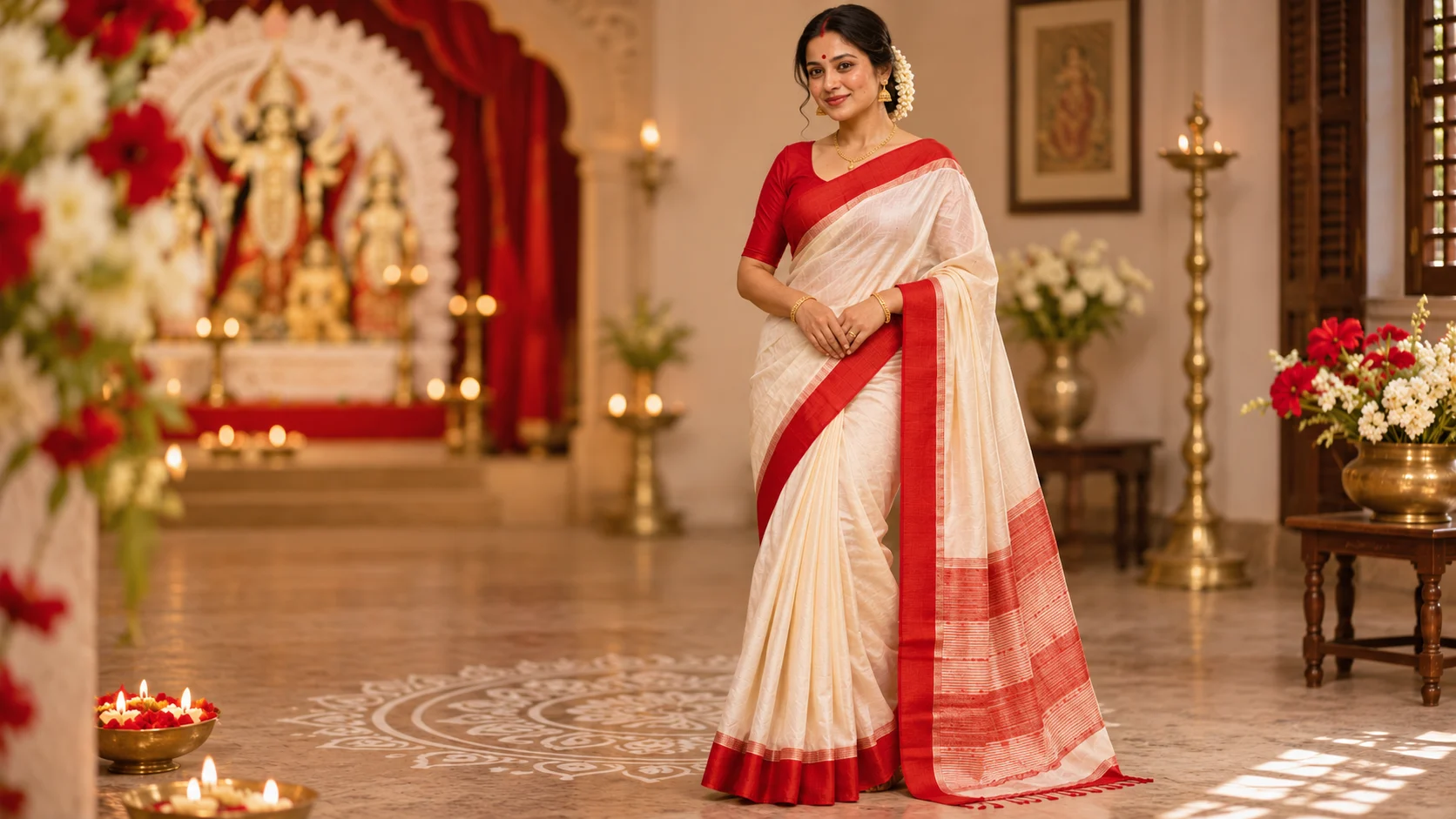

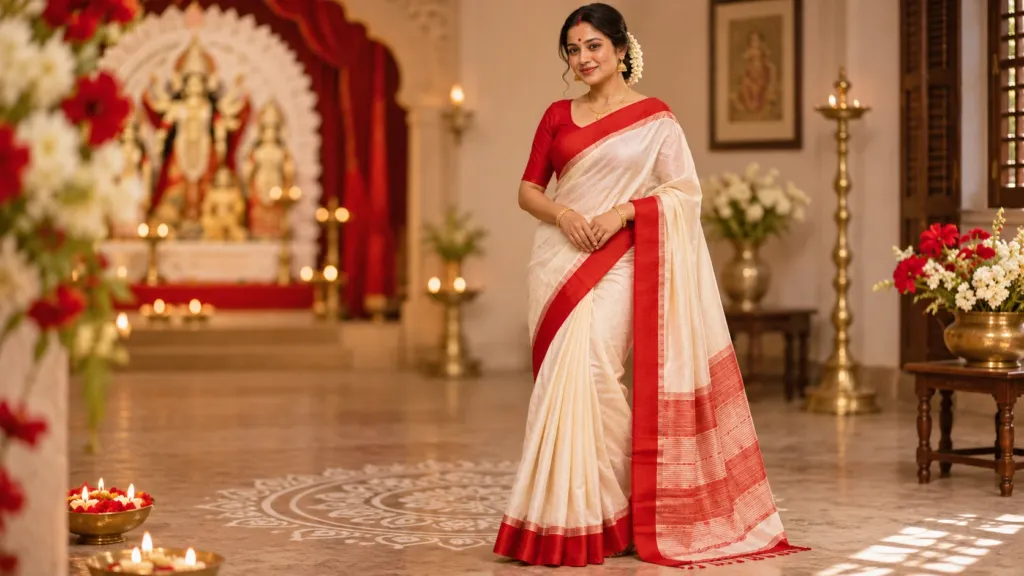
A sada saree lal par is a white or off-white saree with a red border, and it is one of the most recognisable pieces of Bengali clothing. It is worn for Durga Puja rituals, weddings, festivals and everyday life, and it comes in cotton, silk and blends. If you are planning to buy one online, the things that matter most are the fabric, the width and weave of the red border, and the maker behind it.
This guide walks you through all of that in plain terms, so you can pick a saree that looks right, feels right and lasts for years.
What Is a Sada Saree Lal Par?
The name is simple once you break it down. “Sada” means white, “lal” means red, and “par” means border. So a sada saree lal par is a white saree with a red border. You will also see it spelled as laal paar sada saree, or listed as lal par sada saree and sada lal par saree on different shops. They all mean the same thing. Some families still call the silk version a garad saree, after the traditional undyed silk of Murshidabad and Birbhum.
What makes it special is not the colour combination alone. The white body is kept clean and quiet so that the red border can do the talking. In a good piece, the border has weight and structure, sometimes plain, sometimes woven with a fine motif or a thin contrast line. That balance between restraint and richness is why the saree has stayed in fashion for generations without ever feeling dated.
Why Do Bengalis Wear White and Red Together?
In Bengali culture the two colours carry meaning. White stands for purity and calm. Red stands for strength, marriage and the goddess herself. Together they show up at the moments that matter most.
The most famous example is Durga Puja. On Ashtami and Dashami, you will see women in white sarees with bold red borders at pandals across Kolkata, and the whole city seems to wear the same palette. On Dashami, the sindoor khela ritual almost always happens in this combination. The saree is also common at weddings, where relatives and the bride’s side often wear it during rituals, and at Poila Boishakh and other family occasions.
Beyond festivals, many women simply love it as an everyday saree. It is easy to wear, easy to match and never looks like you tried too hard.
Types of Sada Saree Lal Par You Can Buy
Before you add anything to your cart, it helps to know the main families of this saree. The fabric changes how it drapes, how it feels in summer and how much care it needs.
Cotton Lal Par Sada Saree
The cotton lal par sada saree is the one most people reach for first, and for good reason. Tant, mulmul and handloom cotton versions are light, breathable and perfect for Bengal’s long warm months. Tant in particular has a crisp feel that holds pleats well, which makes the saree easy to drape neatly for a full day of puja visits.
If you want a cotton saree that looks sharp but stays comfortable, look at the thread count and the finish. A well-woven cotton feels soft after the first wash and gets better with time. You can explore a range of handloom cotton options in the cotton lal par sada saree collection at Loominators, where the focus is on real handloom weaving rather than mill imitations.
Lal Par Sada Saree in Silk
The silk version is what people choose for weddings, bratas and the days that call for something more formal. A lal par sada saree silk has a soft sheen, a richer fall and a border that often carries woven detail. Garad silk, Bishnupuri silk and katan silk all appear in this style, and each has its own character.
Silk costs more than cotton, but it also gives you a saree you can wear for decades and hand down. If you are buying for a ceremony or gifting it to someone, a lal par sada saree silk is usually the safer choice because it photographs beautifully and drapes with ease.
Blends and Lightweight Weaves
Cotton silk blends sit in the middle. They give you a little of silk’s glow with some of cotton’s comfort, and the price is easier on the pocket. These work well for office wear, family functions and anyone who wants a dressy look without the weight of pure silk.
How to Choose the Right Sada Saree Lal Par
Most buyers go wrong by looking at only one photo and the price. A few quick checks will save you from a disappointing delivery.
Look at the border first. The red should look deep and even, not patchy or bleeding into the white. A wide border feels grand and traditional, while a narrow one feels modern and easy for daily wear. Neither is better, so choose based on where you plan to wear it.
Check the body colour. True white and cream are very different in person. Pure white can look stark under bright light, while off-white looks softer and more forgiving on most skin tones. Product photos can mislead here, so read the description and compare it with the images.
Think about the weave. Handloom pieces show tiny variations in the thread, and that is a good sign rather than a flaw. A saree that looks perfectly uniform at every point may be power-loom made, which is not wrong, but it should be priced accordingly.
Match the fabric to the season. Cotton for summer and monsoon, silk for winter weddings and festive evenings. If you have to wear it for ten hours straight at a puja, cotton is the kinder option.
Plan the blouse. Most sada sarees with lal par come with a matching or contrast blouse piece. Red, white, gold and even black blouses all work. Confirm what is included before you order.
Bengali Lal Par Sada Saree: What Makes It Authentic?
A Bengali lal par sada saree is more than a colour pattern. It comes from specific weaving traditions, and knowing a little about them helps you spot the real thing.
Bengal’s handloom clusters have been producing white and red sarees for centuries. Shantipur, Dhaniakhali and Phulia are known for fine cotton. Murshidabad has a long history with garad silk. Bishnupur in Bankura is famous for katan silk with a distinctive texture. When a saree comes from one of these traditions, the weaver’s skill shows in the evenness of the weave and the way the border joins the body.
For the buyer, authenticity usually comes down to three signs. The first is a clear description of the weave and place of origin. The second is a seller who talks about weavers and sourcing, not just discounts. The third is a fair price. If a so-called pure silk saree is priced like a printed polyester one, something is off.
If you want to see how a Bengali lal par sada saree should look in terms of weave and finish, browsing a curated Bengal handloom range is a good way to train your eye before you buy.
Sada Saree Lal Par for Durga Puja
For many people, this is the main reason to buy. Durga Puja is when the white and red saree is at its most visible, and getting it right makes a difference.
On Ashtami, women often wear a fresh sada saree lal par to offer anjali, and the morning usually starts early. A cotton saree makes sense here because you will be standing, walking and sitting on the floor for hours. For Dashami and sindoor khela, many prefer silk or a heavier cotton so the saree looks festive in photographs.
A few small choices change the whole look. Wear a plain gold or red bangle set and a simple chain rather than heavy jewellery, since the border already gives the saree its richness. Tie your hair in a neat bun with a red flower or a thin band. Keep your footwear comfortable, because pandal hopping is long.
If you are buying for puja, order at least two weeks ahead. Delivery slows down as the festival nears, and you will want time to check the fit, iron the pleats and make any blouse alterations.
How to Style a Lal Par Sada Saree
The saree is simple enough to wear in many ways. Here is how a few different looks come together.
For a traditional look, pair it with a red or white blouse, a bindi, sindoor if you wear it, gold jewellery and alta on your feet. The Bengali drape, with the pallu brought over the left shoulder and a bunch of keys tucked at the end in some families, is the classic way to wear it.
For a modern look, try a contrast blouse in black, mustard or deep green, and keep the jewellery minimal. Oxidised silver earrings work particularly well with white and red. A belt over the saree is another way to bring a younger feel to the drape.
For an office day, choose a narrow border cotton saree with a crisp half-sleeve blouse and small accessories.
How to Care for Your Sada Saree Lal Par
A white saree with a red border needs a little thought when you wash it, mostly because red dye can bleed into the white if handled badly.
For the first wash, rinse the saree on its own in cold water with a mild detergent. Do not soak it for long. Soaking is where most colour bleeding happens. Wash it separately for the first few times, and never mix it with other coloured clothes.
Dry it in the shade, not in direct sun, because strong sunlight can fade the red and yellow the white over time. For cotton, a light starch gives the crisp finish Bengali sarees are known for. For silk, dry cleaning is safer, and you should fold it with a muslin cloth in between to prevent creases on the border.
Store the saree in a breathable cotton bag, away from damp. Refold it every few months along different lines so the fabric does not wear at the folds. If you notice small yellow spots on the white, treat them early with a gentle wash instead of letting them set.
What Affects the Price of a Lal Par Sada Saree?
Prices range widely, and it is useful to know why. Fabric is the biggest factor. A simple cotton saree costs far less than a katan silk one, and a handloom piece costs more than a power-loom piece because of the time a weaver puts in.
Border work also adds to the price. A plain red border is the most affordable, while a woven motif, zari line or contrast thread work takes more time and raises the cost. The size of the saree, the quality of the yarn and whether it comes with a blouse piece also play a part.
If you are comparing prices across stores, look at the fabric description and weave details, not just the number. A cheaper saree is not always the better deal if it fades after two washes.
Why Buy a Sada Saree Lal Par from Loominators?
Loominators is a Kolkata-based store that works with Bengal’s handloom tradition, and the focus is on sarees that look good on the first day and stay good over time. You can browse the full sada saree lal par range and compare cotton, silk and blends in one place instead of jumping between websites.
A few things make the experience easier. Product pages describe the fabric and weave clearly so you know what you are getting. Photos show the border and body in natural light. You can check blouse details before ordering, and support is available if you have questions about sizing, fabric or delivery.
Buying online should feel as confident as walking into a shop in Gariahat or New Market. That is the standard Loominators aims for.
Common Mistakes to Avoid When Buying Online
Some errors come up again and again, and they are easy to dodge once you know them.
Many buyers choose purely by photo and ignore fabric details. Others forget to check whether a blouse piece is included, or order too late for a festival. A few buy the cheapest option and are surprised when the red bleeds in the first wash. Read the product description fully, compare at least three sarees, check the return policy and order early.
Frequently Asked Questions About Sada Saree Lal Par
What is a sada saree lal par?
It is a white or off-white saree with a red border, traditional in Bengal and worn for festivals, rituals, weddings and everyday occasions. It is available in cotton, silk and blended fabrics.
Which fabric is best for a sada saree lal par?
Cotton is best for summer, long festival days and daily wear because it is light and breathable. Silk suits weddings, bratas and formal events where you want a richer look and fall.
Can I wear a lal par sada saree outside Durga Puja?
Yes. Though it is closely linked with Durga Puja, many women wear it for weddings, Poila Boishakh, family functions and even to work. A narrow border cotton version is especially easy for daily use.
How do I stop the red border from bleeding onto the white?
Wash the saree separately in cold water with a mild detergent for the first several washes, avoid long soaking, and dry it in the shade. If the dye is good quality, bleeding reduces after the first couple of washes.
How can I tell if a sada saree lal par is handloom?
Look for slight, natural irregularities in the weave, a clear origin and weave description from the seller, and a price that matches the effort involved. Perfectly uniform fabric at a very low price is often power-loom or synthetic.
What blouse goes best with a sada saree lal par?
Red, white and gold are the safe classics. For a modern look, black, mustard, deep green or navy contrast blouses also work well, especially with minimal jewellery.
Final Thoughts
A sada saree lal par is one of those rare pieces that is both traditional and effortless. It suits a puja morning, a wedding ritual and a regular Tuesday equally well, and it only gets more loved as it ages in your wardrobe.
Choose the fabric based on where and how long you will wear it, look closely at the border and weave, and buy from a seller who is clear about what they offer. If you are ready to shop, explore the collection at Loominators and find a white and red saree that feels like it was made for you.