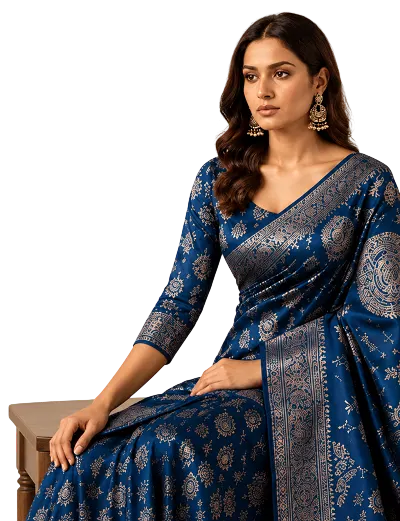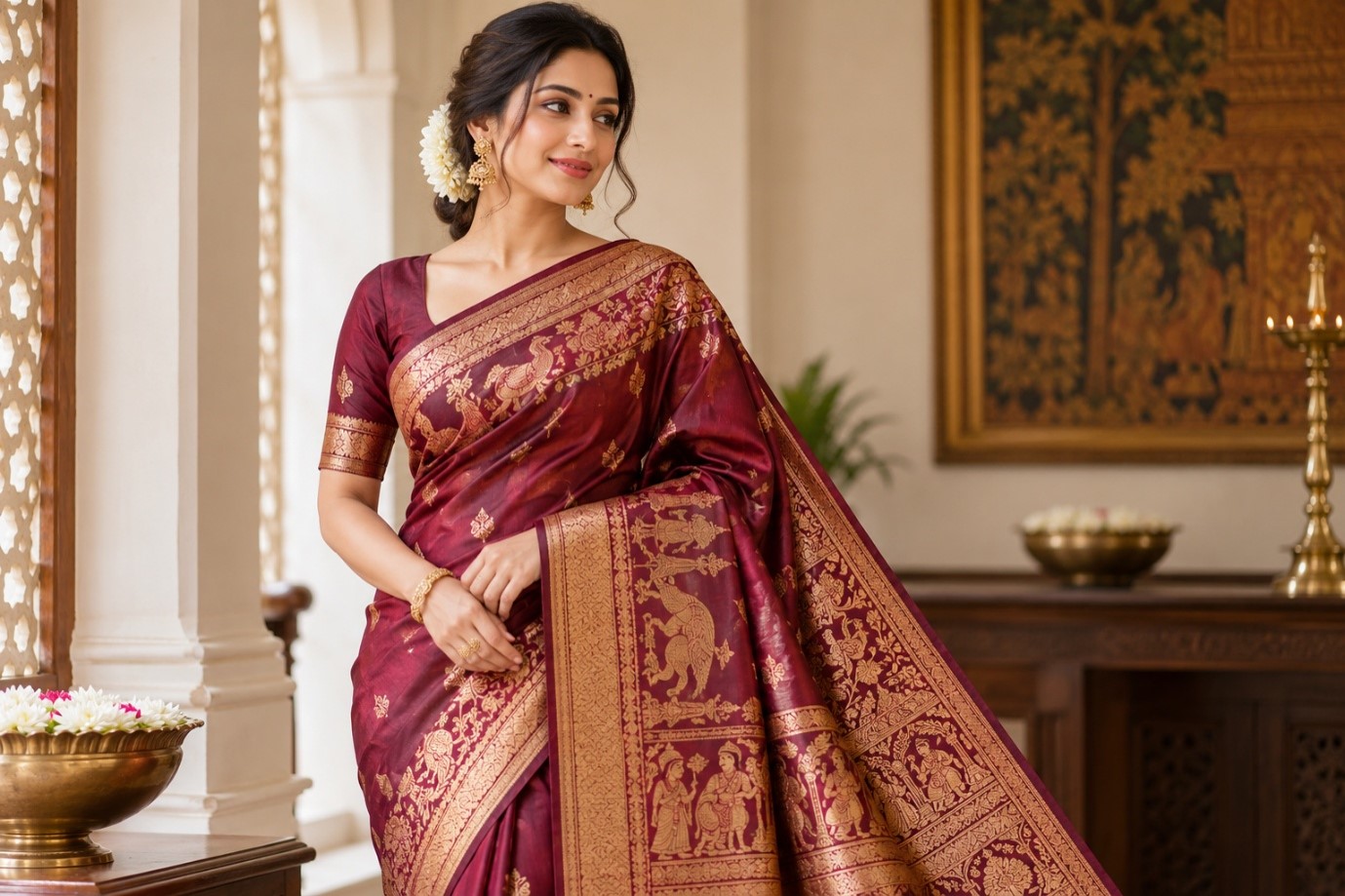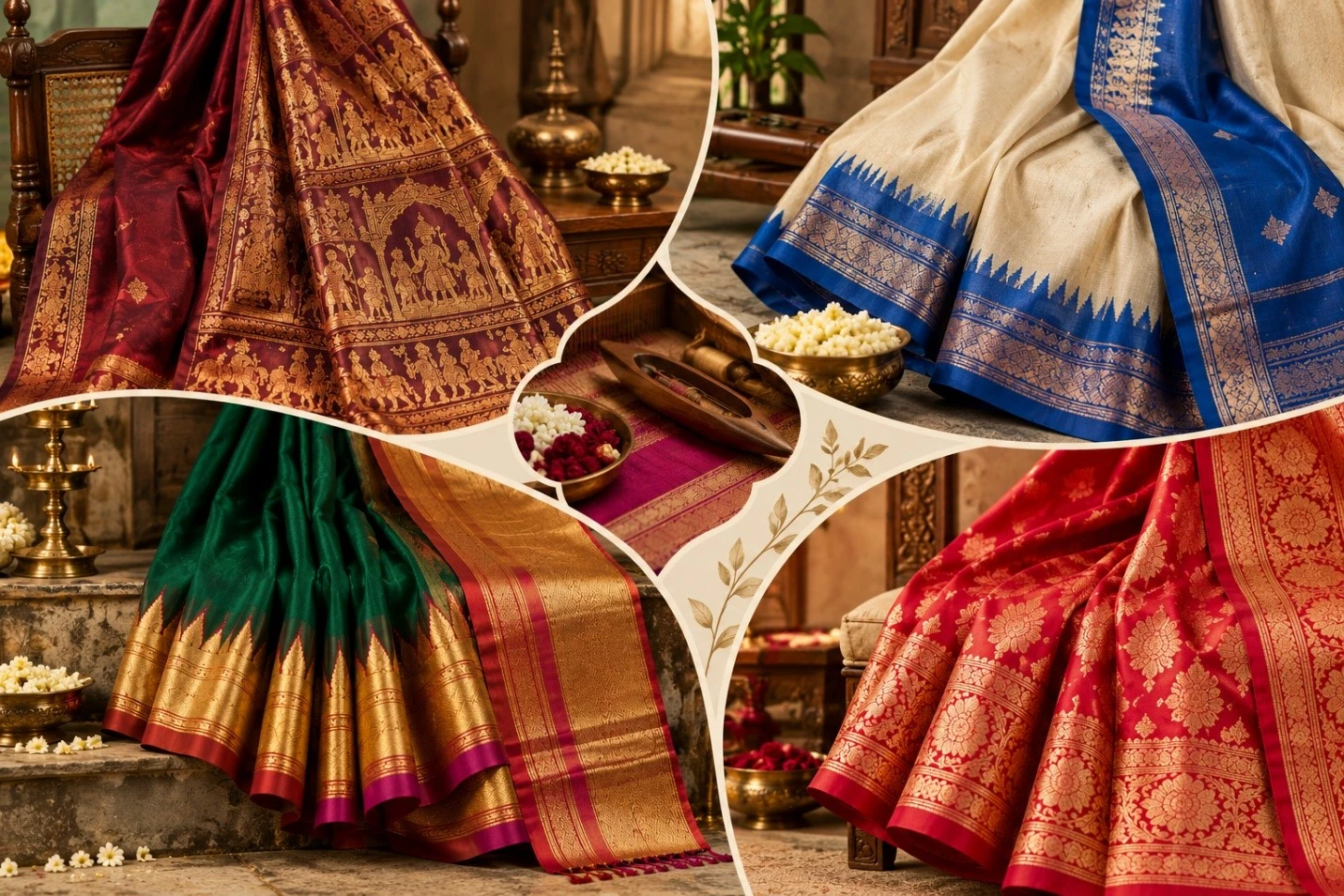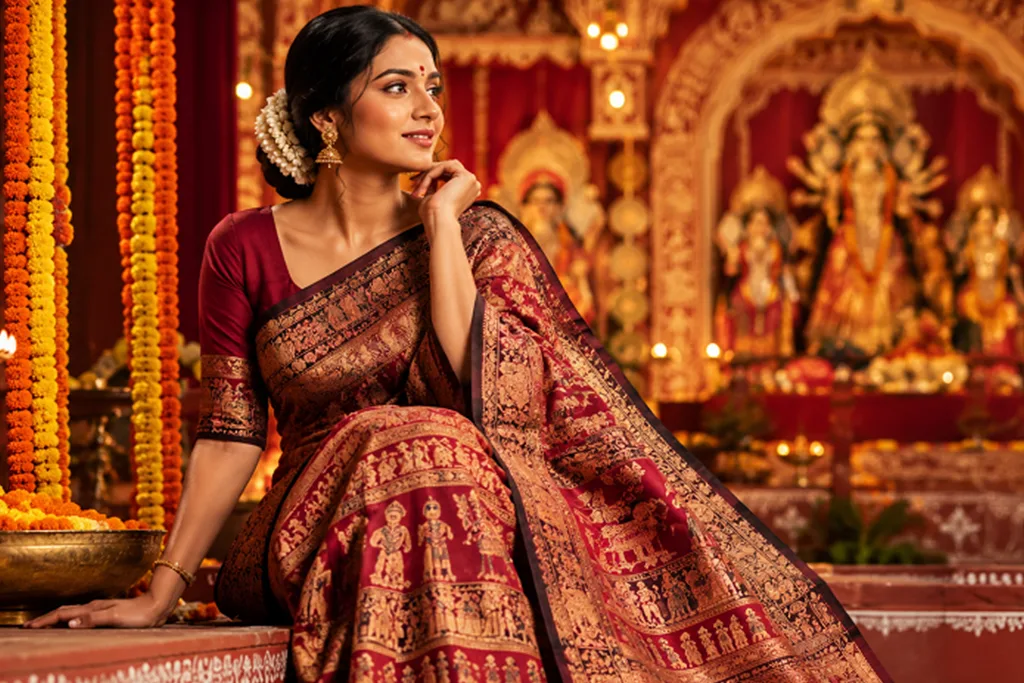

The short answer first. The different types of saree for reception that work best are Banarasi tissue and katan silk, Kanjivaram, Baluchari and Swarnachari, Bishnupuri katan silk, Tussar with kantha work, organza, sequin georgette, embroidered net, velvet for winter evenings and the pre-draped saree gown. Brides and close family usually go for the heavier silks. Guests who plan to dance and eat in comfort lean towards the lighter, shinier fabrics.
That list is the easy part. Picking the right one for your evening, your role and your budget is where most people get stuck, so the rest of this guide walks through each type the way we’d explain it to a customer standing at our counter in Kolkata.
Why a reception saree is a different job from a wedding saree
Think about the room. A wedding ritual usually happens in daylight or under warm, even light, and nobody minds if you sit on the floor for two hours in a stiff silk. A reception is another story. You’re standing on a stage under strong LED panels, greeting a queue of 300 guests, posing for a photographer who keeps saying “one more”, and then trying to eat fish fry without staining the pallu.
So a good saree for reception has to do three things at once. It should catch light, because evening photos flatten dull fabric. It should drape cleanly for hours. And it shouldn’t weigh you down by the third hour. A 1.2 kg Banarasi looks stunning in the first frame and feels like armour by 10 pm.
The good news is that reception dressing gives you more freedom than the wedding itself. Pastels, metallics, wine, emerald and even black are all fair game, and nobody expects the traditional red and white or red and gold.
12 different types of saree for reception
We’ve grouped these roughly from heavy heritage handlooms to lighter, party-style fabrics. Every one of them has a place. The trick is matching it to how long you’ll be standing and how close to the couple you are.
1. Banarasi tissue silk
Tissue Banarasi uses metallic zari in the weft, which gives the whole surface a soft, liquid shine. Under stage lights it glows rather than glares, which is exactly why so many brides switch to tissue for the reception after wearing a heavier katan for the wedding.
It’s lighter than it looks. A gold or champagne tissue with a contrast border is one of the safest bets if you want a rich look without the weight. You’ll find several weaves in our Banarasi silk saree collection, including tissue and Ikat variants.
2. Banarasi katan silk
Katan is pure silk woven from twisted filament, and it’s the fabric people picture when they say “Banarasi”. It’s dense, it holds its pleats, and the brocade work stands out from across a hall. Banaras brocades and sarees carry a Geographical Indication tag, which is worth knowing when you check authenticity.
Our honest advice: wear katan if you’re the bride, the bride’s mother or a very close relative. As a guest it can feel a bit much for an evening event unless the family has asked for traditional wear.
3. Kanjivaram and temple border silk
Kanchipuram silk is heavy, lustrous and built to last decades. The classic temple border, with its triangular gopuram motifs, reads beautifully in photos. In the korvai technique the border and body are woven separately and interlocked by hand, which is why a good korvai has such a crisp colour break.
South Indian receptions almost always feature at least a few Kanjivarams, but they work just as well at a Bengali bou bhaat. Browse our temple border and korvai silk sarees if you like that contrast-border look.
4. Baluchari and Swarnachari
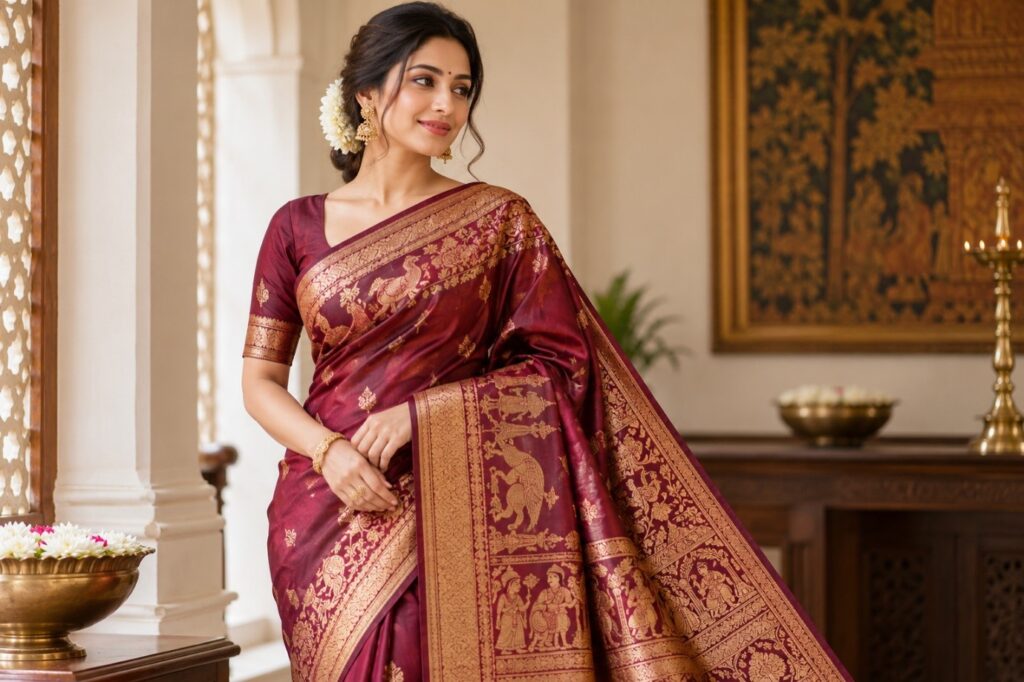
This is Bengal’s storytelling saree. The pallu carries woven scenes from the Ramayana, Mahabharata or court life, and Swarnachari adds gold zari to those motifs so they shimmer. Baluchari is woven mainly in Bishnupur in Bankura district and has its own GI tag.
For a Bengali reception, very few sarees start conversations the way a Baluchari does. Guests will literally stop to look at the pallu. Have a look at our Baluchari and Swarnachari silk sarees for deep maroon, bottle green and midnight blue options that suit night lighting.
5. Bishnupuri katan silk
Lighter than Banarasi, with a slightly crisp hand and a natural sheen, Bishnupuri silk is underrated as reception wear. It suits women who want real silk but can’t bear a heavy drape for four hours.
Pick one with a bold zari border and a solid jewel-tone body. Our Bishnupuri silk saree range is our largest silk section, so there’s a lot of colour to choose from.
6. Tussar silk with kantha or kalamkari work
Tussar comes from wild silkworms, so it has a matte, golden-beige texture that’s very different from mulberry silk. On its own it can look a little understated at night. Add dense kantha embroidery or a hand-painted border, though, and it becomes one of the most elegant choices in the room.
It’s ideal for the guest who prefers craft over bling. A Tussar silk saree with kantha embroidery paired with oxidised silver or antique gold jewellery is a look people remember.
If you love kantha but want a softer base, our kantha stitch sarees on silk and blended fabrics are worth a scroll too.
7. Organza
Organza is sheer, crisp and slightly stiff, which means it holds a structured pleat and photographs with a soft glow. Floral embroidered and hand-painted organzas in powder blue, blush or mint have become the default “modern reception” look over the last few seasons.
One warning. Organza creases at the knees if you sit for a long dinner, so pin the pleats properly and avoid very pale colours if the venue serves curry-heavy food.
8. Sequin georgette
If you want to be visible from the back of a banquet hall, sequins do the job. Georgette is light and flowy, so even a fully sequinned saree stays wearable through a dance floor session.
Go for tonal sequins (silver on grey, gold on champagne, black on black) rather than multicoloured ones. They look more expensive in photos and don’t clash with your jewellery.
9. Embroidered net
Net sarees with zardozi, stone or thread work are a favourite with younger guests and the bride’s friends. They’re light, sheer and glamorous without the weight of brocade.
The catch is that net shows every flaw in the drape. Get the pleats steamed and pinned before you leave home, and wear a well-fitted petticoat in a matching shade.
10. Chiffon or georgette with heavy border
Plain chiffon or georgette with a broad embroidered or gota border is the practical choice nobody talks about. It drapes beautifully on almost every body type, it’s easy to carry through a long evening, and it suits a blouse with sleeves if the venue’s air conditioning is set to arctic.
11. Velvet (for winter receptions)
December and January receptions in North India and even in Kolkata can get chilly in open-air lawns. A velvet saree, or a silk saree paired with a velvet blouse, solves the warmth problem without a shawl hiding your outfit. Deep wine, emerald and navy look richest in velvet.
12. Pre-draped saree and saree gown
The pre-draped saree is stitched so it slips on in about two minutes. It’s a lifesaver for anyone who doesn’t drape regularly, for brides changing quickly between ceremonies, and for guests who’ll be on their feet all night. Pant-style and cape-style versions fall into this group too.
Purists may grumble. But if the choice is between a perfectly pleated pre-draped saree and a hand-draped one sliding off your shoulder by 9 pm, we’d pick the first every time.
Reception saree types compared at a glance
| Saree type | Weight and feel | Best for | Season |
|---|---|---|---|
| Banarasi tissue silk | Light, liquid shine | Bride, close family | All year |
| Banarasi katan silk | Heavy, structured | Bride, mother of the couple | Winter, spring |
| Kanjivaram / temple border | Heavy, lustrous | Bride, family, traditional guests | All year |
| Baluchari / Swarnachari | Medium, soft silk | Bengali receptions, bou bhaat | All year |
| Bishnupuri katan silk | Light to medium, crisp | Family, guests who want real silk | All year |
| Tussar with kantha | Medium, matte texture | Craft-loving guests | Autumn, winter |
| Organza | Light, crisp, sheer | Bride’s friends, cocktail-style receptions | Summer, spring |
| Sequin georgette | Light, flowy | Guests who will dance | All year |
| Embroidered net | Very light, sheer | Younger guests | Summer, spring |
| Chiffon / georgette with border | Very light, soft | Colleagues, casual guests | Summer, monsoon |
| Velvet | Heavy, warm | Open-air winter receptions | Winter |
| Pre-draped saree / saree gown | Varies | Quick changes, first-time drapers | All year |
Which saree for reception suits your role
Who you are at the reception matters as much as the fabric.
- The bride: a lighter heritage silk than the wedding day saree, usually Banarasi tissue, Kanjivaram or Baluchari, in a colour that contrasts with the wedding look.
- Mother or close family of the couple: Banarasi katan, Kanjivaram or Bishnupuri silk in jewel tones. It signals the occasion without competing with the bride.
- Bride’s friends and cousins: organza, sequin georgette or embroidered net. Light enough to dance in.
- Guests at a Bengali bou bhaat: Baluchari, Tussar with kantha or a Bishnupuri silk always feels right, and older relatives will notice the craft.
- Office colleagues and casual guests: chiffon with a rich border or a soft tissue saree keeps it elegant without overdressing.
Colours that photograph well at night
Evening photography is harsh on some shades. Dull mustard, dusty grey and flat beige tend to wash out under white stage lights, while colours with depth hold up beautifully.
The shades we see working best at receptions are wine and burgundy, emerald and bottle green, royal and midnight blue, champagne gold, rose gold, and blush pink with metallic thread. If you’re unsure, pick a deep body colour with a gold or silver border. It almost never goes wrong.
Mistakes we see people make with reception sarees
A few patterns come up again and again with customers in Kolkata.
The first is repeating the wedding look. If you wore red Banarasi for the wedding, a red Banarasi at the reception makes the two sets of photos blur together. Change either the colour or the weave.
The second is stacking a heavy saree with heavy jewellery. A 1 kg silk plus a kundan set plus a long reception equals a sore neck and a tired smile in every late-night photo. Let one of the two be the star.
The third is buying online without checking the blouse piece and the fall. Ask whether the saree has an attached blouse fabric, how long it is, and whether the fall and pico are done. Stitching a blouse takes most tailors in Kolkata 5 to 10 days during wedding season, so order at least three weeks ahead.
And the last one: skipping a trial drape. Wear the saree at home for an hour with your actual heels. You’ll find out quickly whether the pleats behave and whether the pallu slips.
How to buy a handloom saree for reception online
Handloom is still a huge part of how India dresses. The Fourth All India Handloom Census (2019-20) counted 26,73,891 handloom weavers and 8,48,621 allied workers, according to data shared by the Ministry of Textiles. That’s more than 35 lakh people, and a lot of power-loom copies are sold online using their designs.
A few checks help you get the real thing:
- Look for Silk Mark or GI details in the product description for Banarasi, Kanjivaram and Baluchari.
- Ask the seller for a close-up video of the border and pallu. Handwoven zari has tiny irregularities, while machine work is perfectly uniform.
- Read the return and exchange policy before paying, especially for silk.
- Check the length (usually 5.5 m plus a 0.8 to 1 m blouse piece) and the fabric weight if it’s listed.
You can browse our full saree collection by weave, and every product page lists fabric, length and care details. If you’re also planning for the festive season, our guide to Durga Puja outfit ideas covers day-to-night looks that double up well for wedding season.
Picking your reception saree in two minutes
Here’s the rule we give customers. If you’re the bride or immediate family, choose a heritage silk (Banarasi tissue, Kanjivaram, Baluchari or Bishnupuri) in a colour that’s different from the wedding look. If you’re a guest who wants comfort, choose organza, sequin georgette or embroidered net. If you love craft and want to stand out quietly, choose Tussar with kantha.
Still unsure? Message us on WhatsApp at +91 98300 54864 with your event date, your role and a photo of your jewellery, and our Kolkata team will shortlist three sarees from the Loominators collection for you.
Frequently asked questions
What type of saree is best for a reception party?
A light heritage silk such as Banarasi tissue, Kanjivaram or Baluchari works best for the bride and close family. Guests usually prefer organza, sequin georgette or embroidered net because they’re lighter and easier to wear through a long evening.
Which saree is best for a wedding reception guest?
Organza, sequin georgette and chiffon with a rich border are the most comfortable choices for a guest. If the family is traditional, a Bishnupuri silk or a Tussar with kantha work looks elegant without upstaging the couple.
Can I wear a Banarasi saree for a reception?
Yes. Banarasi tissue is one of the most popular reception sarees because it shines under evening lights and is lighter than katan. Choose katan only if you’re the bride or very close family.
What colour saree is good for a night reception?
Deep shades photograph best at night. Wine, emerald, royal blue and champagne gold are reliable picks, and a dark body with a gold or silver border almost never goes wrong.
Is a pre-draped saree okay for a reception?
Absolutely. Pre-draped sarees and saree gowns are now common at receptions, especially for people who don’t drape often or need to change quickly between events.
Which Bengali saree is good for a bou bhaat reception?
A Baluchari, Swarnachari, Bishnupuri katan silk or a Tussar with kantha embroidery is the classic Bengali choice. A Banarasi is also widely worn at bou bhaat receptions in Kolkata.
How far in advance should I buy a reception saree?
Buy at least three to four weeks before the event. That leaves time for delivery, blouse stitching (5 to 10 days in wedding season), fall and pico, and a trial drape at home.